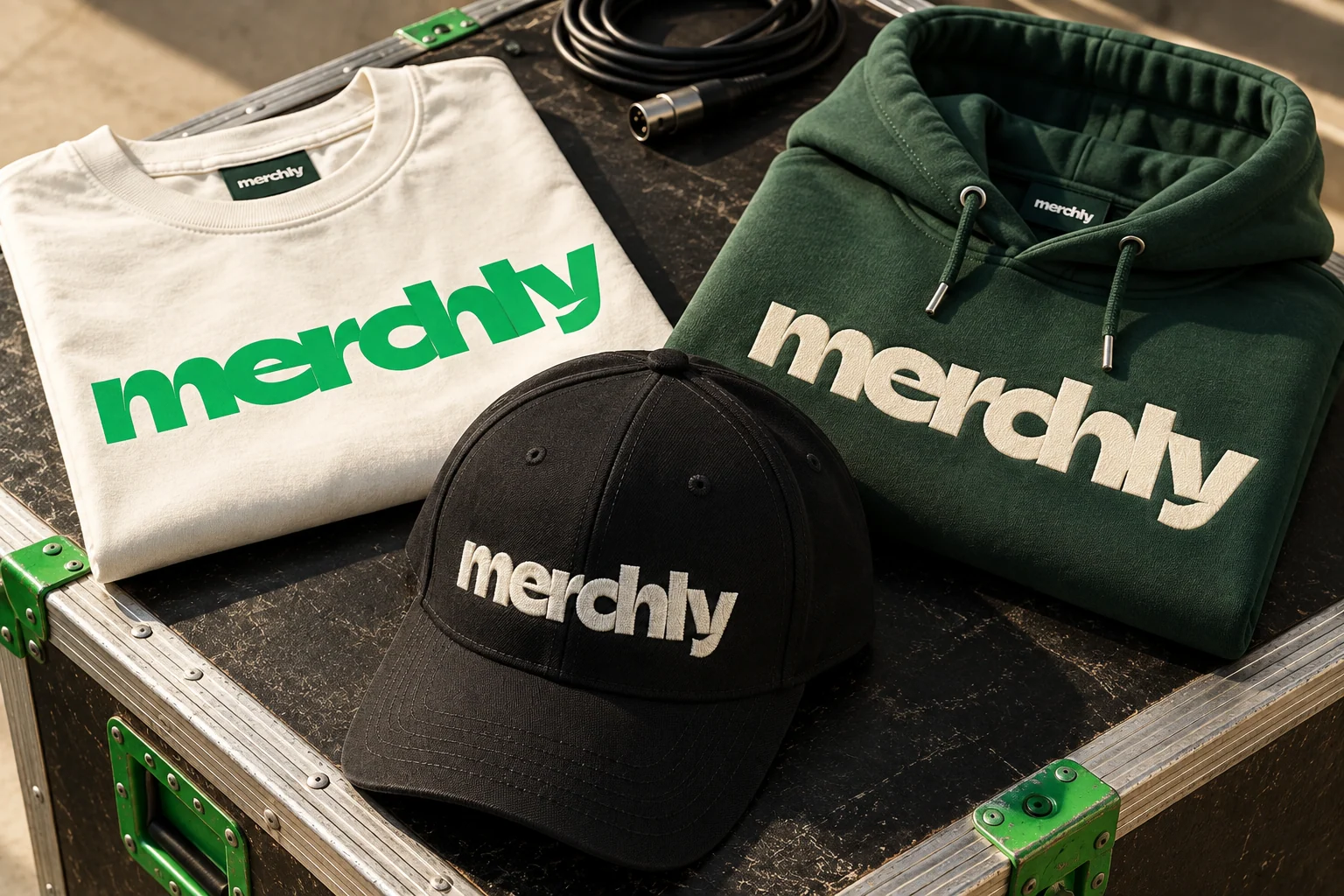
A considered merchandise range can start from €300 for a club release. Budget grows with the scale of the project: products, quantities, tour dates and finish all play a part.
By the Merchly Studio team · Updated 20 September 2026 · 3 min read
The short answer
You can launch a considered merchandise range from €300. That is the first number to remember, because it surprises people: a club release can start with a few dozen pieces, rather than thousands. From there, everything scales. As an indication, allow €3,000–7,000 for a larger venue, €8,000–50,000 for a national tour, and €30,000–100,000 or more for arena and festival tours.
These are indicative budgets. Your quote is built around your product selection, quantities, finishes, logistics and schedule.
Five costs to include
Design: artwork development, adaptations and product mock-ups.
Production: garments or objects, branding, labels and finishing.
Packaging: individual packing, collector’s boxes, inserts and assembly.
Logistics: transport, storage, transfers between dates and final stock handling.
Sales: payment processing, stand staffing and any venue charges agreed in your contract.
A quote may cover only part of this list. Ask which items are included so you can compare the full project cost.
Quantity is a decision, not a guess
Start with the tour dates, audience, sales channels and previous results if available. Estimate demand by product and size. Attendance is not the same as the number of buyers, and a hoodie does not necessarily sell at the same rate as a t-shirt.
Build cautious, central and stronger-sales scenarios. Check the cash needed before the first show and the stock left if the cautious scenario occurs.
Separate revenue from margin
Revenue is the selling price multiplied by units sold. It is not profit. Deduct product costs and the relevant selling expenses, then account for any other project costs and applicable taxes with your finance team.
A percentage margin can look healthy while cash remains tied up in unsold stock. Keep a separate view of the production order, actual sales and remaining inventory.
Keep the first range focused
A coherent selection is easier to present and count. Each extra colour or size increases the number of stock references. Prioritise the pieces with the clearest role in the collection, and discuss reorder feasibility before relying on it.
Track sales by size and date using a consistent method.Merchly Apphelps bring payments, stock and tour reporting together.
Prepare a quote that answers the real brief
Send the product ideas, artwork status, quantities, branding, required stock arrival date and delivery plan. Ask for the specification behind each price. Samples, packaging and rush work should be identified rather than assumed.
Figures from other projects are only reference points. Your own quote depends on the actual product, process, volume and calendar.
Is the cheapest unit price always the best option?
No. Compare the same product specification and include packaging, transport and selling costs. A lower unit price can also mean a larger upfront order.
How do we reduce unsold stock?
Use previous sales where available, keep the range focused, track sizes and discuss reorders. No forecast removes demand uncertainty.
GUIDE TO YOUR PROJECT
Shall we move on to your project?
Start with an idea. We refine products, quantities and details together.